 Neel Thakkar

Manufacturing companies today face increasing pressure to deliver faster, operate more efficiently, and meet evolving customer expectations while managing complex supply chains and production processes. Relying on manual systems and disconnected tools often leads to delays, errors, and missed opportunities. To stay competitive, manufacturers must adopt smarter, more integrated solutions that streamline operations and provide real-time visibility across departments.
Salesforce automation helps manufacturing companies simplify workflows, improve collaboration, and enhance decision-making. By using Salesforce for manufacturing, businesses can automate lead management, quoting, order processing, and service operations while reducing manual effort. These capabilities strengthen a manufacturing CRM strategy and allow organizations to focus on growth-driven activities. In this guide, we'll explore the top Salesforce automations every manufacturing company should implement, how they work, and the business value they deliver.
Why Automation Is Essential for Manufacturing Companies

- Manufacturing companies manage multiple business processes every day, from lead management and quotations to production planning, inventory tracking, and customer service. When these activities rely on manual effort, they often lead to delays, errors, and inefficient collaboration between teams.
- Salesforce automation helps streamline these processes by connecting departments through intelligent workflows and supporting manufacturing workflow automation. It reduces repetitive tasks, improves operational visibility, and ensures the right information reaches the right people at the right time, enabling manufacturers to operate more efficiently and scale with confidence.
- It reduces repetitive tasks, improves operational visibility, and ensures the right information reaches the right people at the right time, enabling manufacturers to operate more efficiently and scale with confidence.
Some of the key reasons manufacturing companies are investing in automation include:
- Automation eliminates repetitive tasks such as assigning leads, updating records, sending reminders, and requesting approvals, allowing employees to focus on higher-value work.
- Automated lead routing, follow-up reminders, and opportunity management help sales teams spend less time on administrative tasks and more time building customer relationships and closing deals.
- Automated order confirmations, production updates, service notifications, and maintenance reminders keep customers informed throughout their journey, improving response times and customer satisfaction.
- Automation connects sales, production, inventory, finance, logistics, and customer service teams through real-time data, improving collaboration and reducing operational delays.
Common Challenges Manufacturers Face Without Automation
Before implementing automation, many manufacturing organizations struggle with operational inefficiencies that affect customer satisfaction and profitability.
Let's look at some of the most common challenges.
Slow Lead Response
- Receive inquiries from multiple sources like websites, trade shows, and distributors
- Lack of automated lead assignment causes delays in response
- Leads often remain unassigned or wait for manual review
- Slow responses result in missed sales opportunities
Manual Quote Approvals
- Quotations often require multiple approvals for pricing, discounts, or custom products
- Approval processes are commonly managed through emails or spreadsheets
- This slows down the sales process and extends deal cycles
- Delays may lead potential customers to choose competitors
Disconnected Sales and Production Teams
- Production teams require complete and accurate order details after deal closure
- Manual handoffs often create communication gaps between teams
- These gaps can lead to manufacturing delays and scheduling conflicts
- Missed delivery commitments can negatively impact customer satisfaction
Inventory Shortages
- Manual inventory tracking makes it difficult to identify stock shortages early
- Shortages often go unnoticed until they impact production schedules
- This leads to delays in manufacturing and order fulfillment
- It also increases emergency procurement costs and disrupts deliveries
Delayed Service Response
- Service requests may remain unassigned or be routed to the wrong technician
- Delays in handling maintenance, warranty, or technical support issues
- Increased equipment downtime affecting operations
- Negative impact on customer satisfaction and service quality
Top 10 Salesforce Automations Every Manufacturing Company Should Implement
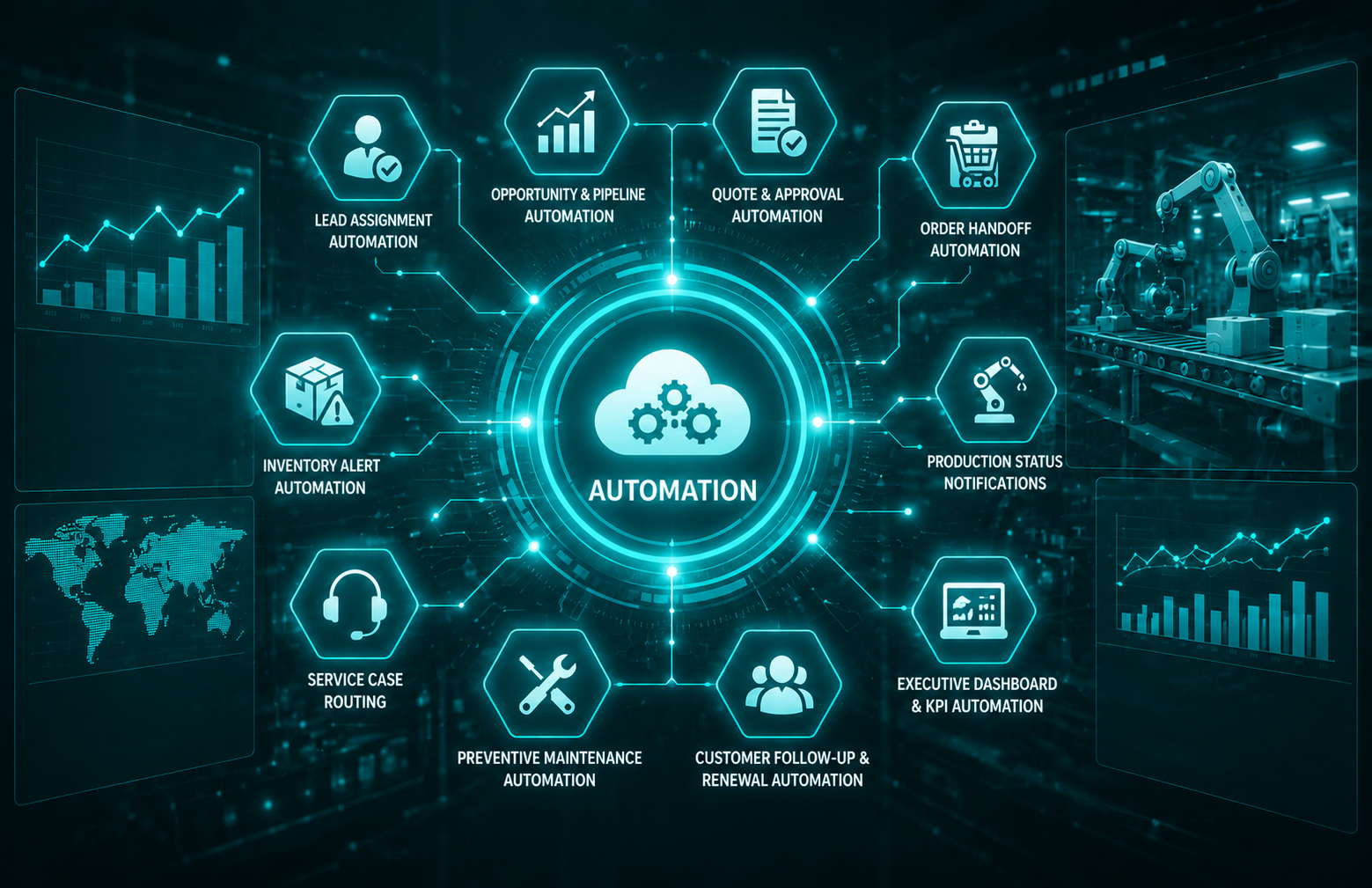
1. Lead Assignment Automation
- Manufacturing companies receive leads from multiple channels, including websites, trade shows, partner referrals, distributors, and marketing campaigns. Without automation, these inquiries are often reviewed and assigned manually, leading to delayed responses and missed sales opportunities.
- Using Salesforce automation and Salesforce Flow, manufacturers can automatically capture and assign leads to the right sales representative based on predefined rules such as industry, product interest, territory, or location. This ensures every inquiry is routed quickly, allowing sales teams to respond faster and improve the overall customer experience.
How Salesforce Automates It
- Captures leads from websites, forms, and other integrated channels.
- Assigns leads automatically based on territory, industry, or product interest.
- Creates follow-up tasks for sales representatives.
- Sends instant notifications to the assigned sales representative.
- Alerts managers about high-value or priority leads.
- Updates lead ownership and activity records automatically.
Key Benefits
- Faster lead response times.
- Improved lead conversion rates.
- Balanced workload across sales teams.
- Reduced manual effort and administrative work.
- Better customer experience through quicker engagement.
2. Opportunity & Sales Pipeline Automation
- Sales opportunities in manufacturing often move through multiple stages, from qualification and product demonstrations to negotiations and final approvals. Without automation, sales representatives may forget follow-ups or delay updating opportunity records, making pipeline tracking and forecasting less reliable.
- Salesforce automation helps sales teams automate opportunity updates, follow-up activities, and forecasting, strengthening overall CRM automation while ensuring every opportunity follows a consistent sales process.
How Salesforce Automates It
- Triggers follow-up tasks when opportunity stages change.
- Schedules customer meetings and reminders automatically.
- Sends notifications to sales managers for high-value deals.
- Updates opportunity records and sales forecasts.
- Initiates quote generation and technical consultations when required.
Key Benefits
- Improved sales pipeline visibility.
- More accurate revenue forecasting.
- Consistent sales processes.
- Higher sales productivity.
- Reduced manual follow-up efforts.
3. Quote & Approval Automation
- Manufacturing quotations often require multiple approvals due to custom pricing, discounts, shipping costs, or product configurations. Managing approvals through emails or spreadsheets can delay customer responses and extend the sales cycle.
- Salesforce automates the approval process by routing quotes to the appropriate stakeholders based on predefined business rules, ensuring faster approvals while maintaining pricing compliance.
How Salesforce Automates It
- Routes quotes automatically based on pricing or discount rules.
- Sends approval requests to the appropriate managers.
- Notifies finance or engineering for special requests.
- Sends reminders for pending approvals.
- Updates approval status automatically once completed.
Key Benefits
- Faster quote approvals.
- Improved pricing governance.
- Better compliance and audit tracking.
- Shorter sales cycles.
- Improved customer responsiveness.
4. Order Handoff Automation
- Once a deal is won, sales teams must transfer order information to production, finance, procurement, logistics, and customer service. Manual handoffs often result in delays, incomplete information, and communication gaps between departments.
- Salesforce automatically initiates downstream processes after an opportunity is marked as Closed Won, ensuring every department receives accurate information at the right time.
How Salesforce Automates It
- Creates production or manufacturing requests automatically.
- Notifies operations and planning teams.
- Generates fulfillment and onboarding tasks.
- Alerts finance for invoice preparation.
- Sends shipment notifications to logistics teams.
Key Benefits
- Faster order processing.
- Improved collaboration between departments.
- Reduced communication errors.
- Better production planning.
- Enhanced customer experience.
5. Inventory Alert Automation
- Maintaining optimal inventory levels is critical for uninterrupted production. Manual inventory tracking makes it difficult to identify shortages before they impact manufacturing schedules.
- Salesforce supports manufacturing process automation by integrating with ERP and inventory systems to monitor stock levels in real time and notify the appropriate teams before shortages affect production.
How Salesforce Automates It
- Monitors inventory levels continuously.
- Sends low-stock alerts to procurement teams.
- Creates purchase request tasks automatically.
- Notifies production planners about shortages.
- Escalates critical inventory issues when necessary.
Key Benefits
- Reduced stock shortages.
- Improved production continuity.
- Better inventory planning.
- Lower emergency procurement costs.
- Increased operational efficiency.
6. Production Status Notifications
- Customers often request updates about their order status during the manufacturing process. Providing these updates manually consumes valuable employee time and may result in inconsistent communication.
- Salesforce automatically sends production and delivery updates whenever key milestones are completed, improving transparency and customer satisfaction.
How Salesforce Automates It
- Sends notifications when production begins.
- Updates customers after quality inspections.
- Notifies customers when orders are packaged.
- Sends shipment and delivery confirmations.
- Updates customer records automatically.
Key Benefits
- Improved customer communication.
- Fewer support inquiries.
- Increased customer trust.
- Better customer satisfaction.
- Reduced manual follow-up.
7. Service Case Routing Automation
- Manufacturers receive service requests related to equipment maintenance, warranty claims, installations, and technical support. Manual case assignment can delay responses and increase equipment downtime.
- Organizations using Salesforce Manufacturing Cloud together with Service Cloud can automatically route service requests to the most suitable technician based on product type, region, or expertise, improving response times and customer satisfaction.
How Salesforce Automates It
- Categorizes incoming service requests.
- Assigns cases based on product, region, or technician expertise.
- Prioritizes urgent support cases.
- Starts SLA tracking automatically.
- Escalates unresolved cases when needed.
Key Benefits
- Faster case resolution.
- Better SLA compliance.
- Improved technician productivity.
- Reduced equipment downtime.
- Higher customer satisfaction.
8. Preventive Maintenance Automation
- Unexpected equipment failures can disrupt production and increase maintenance costs. Relying solely on reactive maintenance often leads to unnecessary downtime and expensive repairs.
- Salesforce helps manufacturers schedule and manage preventive maintenance automatically, ensuring equipment receives service before problems occur.
How Salesforce Automates It
- Creates recurring maintenance work orders.
- Assigns technicians automatically.
- Schedules maintenance appointments.
- Sends reminders to customers.
- Maintains complete service history.
Key Benefits
- Reduced equipment downtime.
- Longer asset life.
- Better technician scheduling.
- Lower maintenance costs.
- Improved customer satisfaction.
9. Customer Follow-up & Renewal Automation
- Maintaining customer relationships after product delivery is essential for repeat business and long-term growth. Without automation, follow-up activities and renewal opportunities are often overlooked.
- Salesforce automatically schedules post-sale engagement activities to keep customers connected throughout the product lifecycle.
How Salesforce Automates It
- Sends customer satisfaction surveys.
- Schedules follow-up reminders.
- Creates renewal opportunities automatically.
- Sends warranty renewal notifications.
- Recommends additional products or services.
Key Benefits
- Higher customer retention.
- Increased repeat business.
- Better customer engagement.
- Improved renewal rates.
- More upselling opportunities.
10. Executive Dashboard & KPI Automation
- Manufacturing leaders need accurate and up-to-date information to make informed business decisions. Manually preparing reports is time-consuming and often results in outdated insights.
- Salesforce automatically consolidates data from sales, production, inventory, and customer service into real-time dashboards, providing executives with complete visibility into business performance.
How Salesforce Automates It
- Updates sales pipeline dashboards automatically.
- Tracks revenue forecasts in real time.
- Monitors production and inventory performance.
- Displays customer service KPIs.
- Generates real-time business reports.
Key Benefits
- Better business visibility.
- Faster decision-making.
- More accurate reporting.
- Improved strategic planning.
- Increased operational efficiency.
How Salesforce Automation Connects the Entire Manufacturing Process
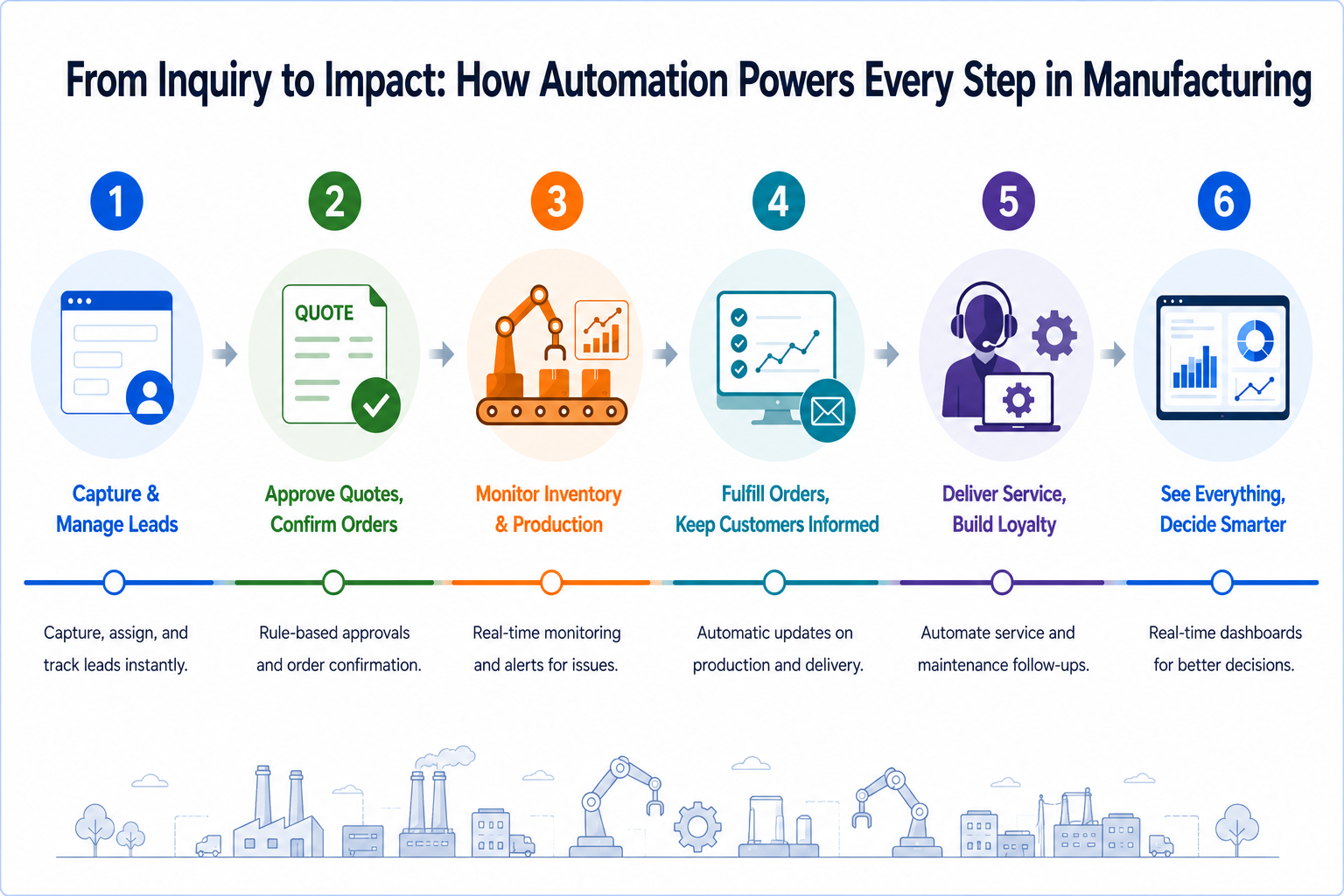
- Manufacturing success depends on seamless collaboration between sales, production, inventory, finance, logistics, and customer service. When these teams rely on manual processes or disconnected systems, it often leads to delays, errors, and limited operational visibility.
- Salesforce automation connects departments through intelligent workflows, enabling real-time information sharing, reducing manual effort, and improving collaboration across the entire manufacturing process.
The following example illustrates how Salesforce connects the entire manufacturing lifecycle through automation.
1. Lead Capture and Opportunity Management
- The journey begins when a prospective customer submits an inquiry through your website, partner portal, trade show, or marketing campaign.
- Salesforce automatically captures the lead, assigns it to the right sales representative, tracks customer interactions, and triggers follow-up activities as the opportunity progresses through the sales pipeline.
2. Quote Approval and Order Confirmation
- Once the customer requests pricing, Salesforce generates a quotation and routes it through the appropriate approval process based on predefined business rules.
- After the quote is approved and accepted, Salesforce automatically transfers order information to production, procurement, finance, and operations teams, ensuring a smooth handoff without manual intervention.
3. Inventory and Production Monitoring
- Salesforce integrates with ERP or inventory management systems to monitor inventory levels, raw material availability, and production milestones in real time.
- Automated alerts notify relevant teams about inventory shortages or production delays, enabling proactive planning and uninterrupted manufacturing operations.
4. Order Fulfillment and Customer Communication
- As production progresses, Salesforce automatically sends order status updates to customers, including manufacturing progress, quality inspections, shipment, and delivery notifications.
- This proactive communication improves transparency, reduces support inquiries, and enhances the overall customer experience.
5. Customer Service and Preventive Maintenance
- After product delivery, Salesforce continues supporting customers through automated service case routing, warranty management, technician scheduling, and preventive maintenance reminders.
- It also helps strengthen long-term customer relationships by sending satisfaction surveys, renewal reminders, and follow-up notifications.
6. Executive Visibility and Business Insights
- Every stage of the manufacturing process is captured within Salesforce, providing executives with real-time dashboards and performance reports.
- This complete visibility helps leaders monitor key performance indicators, improve forecasting, identify operational bottlenecks, and make faster, data-driven business decisions.
Manufacturing Industries That Gain the Most from Salesforce Automation
While all manufacturers benefit from Salesforce automation, those with complex operations and long sales cycles see the most impact. Automation boosts productivity, improves customer experience, and enhances operational visibility.

Automotive Manufacturing
- Automotive manufacturers manage extensive dealer networks, supplier relationships, complex production schedules, and after-sales services.
- Salesforce automation streamlines lead management processes and improves workflow efficiency.
- It simplifies quote approvals and enhances inventory visibility across operations.
- The system also supports effective warranty tracking and service management.
- These improvements enhance overall operational efficiency and strengthen dealer relationships.
Industrial Equipment Manufacturing
- Companies that manufacture industrial machinery often manage complex sales processes and long customer lifecycles.
- Salesforce helps automate opportunity management to improve sales tracking and visibility.
- It streamlines order handoffs between sales and operations teams.
- The platform supports preventive maintenance scheduling to reduce downtime.
- It also enhances field service operations, enabling faster response times and better customer support.
Electronics Manufacturing
- Electronics manufacturers often manage rapid production cycles, global supply chains, and strict inventory requirements.
- Salesforce automation helps streamline inventory tracking for better accuracy and visibility.
- It enables real-time production monitoring to improve efficiency and reduce delays.
- Automation enhances collaboration with suppliers, ensuring smoother supply chain operations.
- It also improves customer communication, leading to better service and operational performance.
Medical Device Manufacturing
- Medical device manufacturers must maintain strict compliance while managing customer relationships and service requests.
- Salesforce helps automate approval workflows to ensure regulatory standards are consistently met.
- It streamlines customer support processes for faster and more efficient service.
- Warranty management becomes more organized and easier to track with automation.
- Maintenance scheduling is simplified, helping organizations improve compliance and deliver exceptional customer service.
How to Get Started with Salesforce Automation for Manufacturing
- Start with a phased implementation rather than automating every process at once. This minimizes disruptions, gives teams time to adapt, and allows workflows to be tested and optimized effectively.
- Assess your existing sales, production, inventory, and service processes to identify repetitive tasks, bottlenecks, and manual activities. Prioritize areas where automation can deliver the greatest business impact.
- Focus on high-value workflows such as lead management, quote approvals, order processing, and customer service. Early success in these areas helps demonstrate ROI and encourages broader adoption.
- Integrate Salesforce with ERP, inventory, and accounting systems to create a unified flow of real-time data. Connected systems improve collaboration and eliminate manual data entry.
- Train employees on new automated workflows and establish standardized processes. Strong user adoption ensures automation delivers consistent and long-term business value.
- Monitor workflow performance regularly using key metrics such as response times, process efficiency, and customer satisfaction. Continuously refine automations to improve productivity and maximize ROI.
Best Practices Before Automating Manufacturing Processes

Successful manufacturing process automation requires careful planning, clean data, and well-defined business workflows. Consider these best practices:
1. Analyze Existing Business Processes
- Review your current sales, production, inventory, and customer service workflows.
- Identify repetitive tasks, manual bottlenecks, and areas prone to delays or errors.
- Analyze inefficiencies that impact productivity and operational performance.
- Ensure automation focuses on solving real business challenges rather than digitizing inefficient processes.
2. Prioritize High-Impact Workflows
- Start by automating workflows that deliver the highest business impact instead of trying to automate everything at once.
- Focus on key processes like lead assignment, quote approvals, and order handoffs.
- Include automation for inventory alerts and service case routing to improve efficiency.
- These high-impact automations provide quick wins and showcase the value of Salesforce early in implementation.
3. Ensure Data Quality
- Automation depends on accurate and consistent data to function effectively.
- Clean duplicate records and standardize customer information before deploying workflows.
- Verify that CRM and ERP data is complete, accurate, and up to date.
- High-quality data improves reporting accuracy, reduces errors, and ensures automated processes perform as expected.
4. Integrate Business Systems
- Manufacturing companies often rely on ERP, inventory management, accounting, and production planning systems alongside Salesforce.
- Integrating these systems enables seamless data sharing across departments.
- It improves collaboration between teams such as sales, operations, and finance.
- Employees gain access to real-time business information for better decision-making.
5. Involve Key Stakeholders Early
- Include input from sales, operations, production, finance, customer service, and IT teams in automation projects.
- Involve stakeholders from the beginning of the planning process.
- This helps identify accurate process requirements and potential challenges.
- It also improves collaboration and encourages organization-wide adoption after implementation.
6. Monitor Performance and Continuously Improve
- Automation should evolve as your business grows and adapts to changing needs.
- Regularly track key performance indicators (KPIs) such as lead response time, quote approval time, and order processing speed.
- Monitor customer satisfaction and service resolution time to evaluate overall performance.
- Use these insights to identify opportunities for optimization and continuously improve your workflows.
Common Mistakes to Avoid
While Salesforce automation can significantly improve manufacturing operations, poor planning and implementation can reduce its effectiveness.
Avoid these common mistakes to ensure a successful automation journey:
- Avoid automating inefficient or outdated processes without first reviewing and optimizing existing workflows to eliminate unnecessary steps.
- Ensure your CRM and ERP data is accurate, complete, and free of duplicate records, as poor-quality data can lead to unreliable automation and reporting.
- Keep automation workflows simple and scalable instead of creating overly complex processes with unnecessary approval layers that slow business operations.
- Involve sales, production, operations, customer service, and other key stakeholders throughout the implementation process to improve collaboration and user adoption.
- Provide employees with proper training and change management support so they can confidently use new automated workflows and maximize productivity.
- Continuously monitor workflow performance, track key business metrics, and optimize automations regularly to ensure they continue delivering value as business needs evolve.
- Avoid relying solely on automation without maintaining human oversight, especially for critical decisions that require judgment and flexibility.
- Ensure proper system integration and testing before deployment to prevent data inconsistencies, workflow errors, and disruptions to business operations.
Conclusion
Manufacturing companies face increasing pressure to boost efficiency, reduce costs, and meet rising customer expectations. Salesforce automation helps streamline sales, production, inventory, and customer service through connected workflows that reduce manual effort and improve operational visibility.
By implementing the right automations, manufacturers can strengthen their manufacturing CRM, improve collaboration across departments, and make faster, data-driven decisions. As part of a broader manufacturing digital transformation strategy, Salesforce enables businesses to scale efficiently, enhance customer experiences, and build a connected foundation for long-term growth.